Understanding Breast Cancer

1 in 7 women in Scotland will develop breast cancer in their lifetime.
Breast cancer is not however a ‘women’s’ health issue. Everyone has breast tissue and people of all genders can be diagnosed with breast cancer.
A complex disease that occurs when abnormal cells in the breast tissue begin to grow uncontrollably, understanding breast cancer is essential for individuals and communities alike.
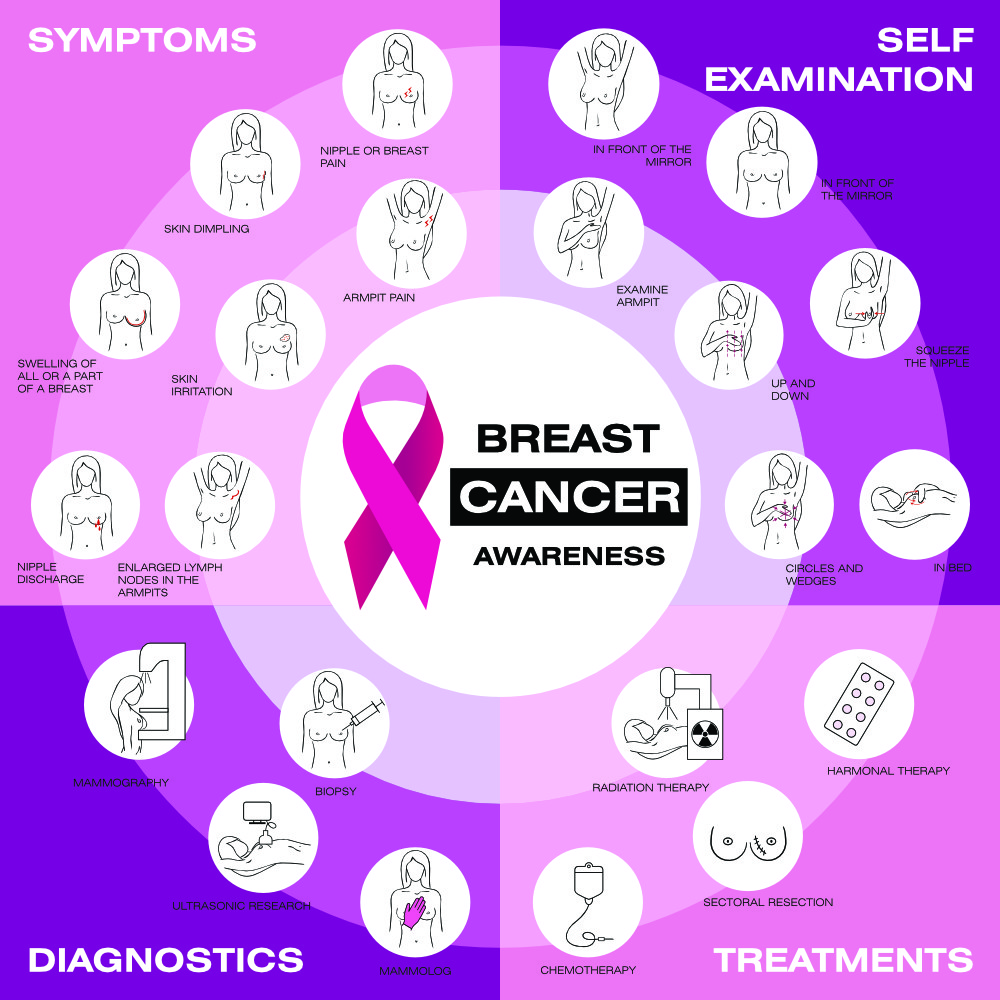
As individuals we need to self-advocate, to know our own bodies and ensure that you are checking your breasts on a regular basis.
If you have any concerns about changes in your body, always consult your GP or local clinician for advice.
Types of breast cancer
There are many different types of breast cancer defined by where in the breast they begin, how much they have grown or spread, and how they behave.
INVASIVE BREAST CANCER
Invasive breast cancer means that cancer cells have spread into the surrounding breast tissue. There are different types of invasive breast cancer, classified according to the appearance and behaviour of the cancer cells and other characteristics.
Invasive breast cancer of no special type (NST), previously known as invasive ductal carcinoma (IDC), is the most common type of invasive breast cancer. It is identified by the appearance and characteristics of its cancer cells, rather than simply where it begins in the breast.
Invasive lobular carcinoma (ILC) is the second most common type of invasive breast cancer. Like NST, it can develop within the terminal ductal-lobular unit, the part of the breast containing the milk-producing glands and small ducts. ILC is distinguished by the way its cancer cells look and grow, often spreading in single lines rather than forming a distinct lump.
Triple-negative breast cancer is a type of breast cancer in which the cancer cells do not have oestrogen or progesterone receptors and do not have high levels of the HER2 protein. It can grow and spread more quickly than some other types of breast cancer, although its behaviour varies.
Inflammatory breast cancer is a rare, fast-growing type of invasive breast cancer. It occurs when cancer cells block lymph vessels in the skin of the breast, often causing swelling, redness or changes in skin colour, warmth and changes to the skin's texture.
Recurrent breast cancer is breast cancer that returns after treatment. It can return in the same breast or nearby area (local recurrence), nearby lymph nodes (regional recurrence), or elsewhere in the body (distant recurrence, also called metastatic breast cancer).
Paget's disease of the breast is a rare form of breast cancer that affects the skin of the nipple and sometimes the darker area surrounding it (the areola). It can cause changes such as redness, itching, flaking or crusting of the skin and is often associated with an underlying breast cancer, which may be invasive or non-invasive.
NON-INVASIVE BREAST CANCER AND RELATED CONDITIONS
Non-invasive breast cancer means that cancer cells remain contained within the structures where they are found and have not spread into the surrounding breast tissue. The most common form is ductal carcinoma in situ (DCIS). There are also related breast conditions, such as lobular carcinoma in situ (LCIS), which are not classified as breast cancer.
Ductal carcinoma in situ (DCIS) is a non-invasive form of breast cancer in which cancer cells are contained within the milk ducts and have not spread into the surrounding breast tissue. DCIS is sometimes called stage 0 breast cancer. Some cases may develop into invasive breast cancer if left untreated, although not all will.
Lobular carcinoma in situ (LCIS) is a condition in which abnormal cells develop within the milk-producing glands (lobules) of the breast. Despite its name, LCIS is not considered breast cancer. However, it is associated with an increased risk of developing breast cancer in either breast in the future. There are different forms of LCIS, some of which may require closer monitoring or treatment.
Feeling unsure or unsettled about this information, Breast Cancer Now has an invaluable helpline which is a great resource with incredibly friendly and knowledgeable people at the end of the line. You can call them on 0808 800 6000 on Monday - Friday, (9am-4pm) and Saturday, (9am-1pm).
Again, we can not stress this enough. If you are concerned about any potential signs or symptoms please do not hesitate to consult your GP or local nurse practitioner.